



If you have stepped foot in a gym, I'd bet on you knowing what a Romanian Deadlift is. If you don’t, it probably sounds a little bit scary (and you pulled a funny face reading the name Romanian Deadlift). But, it isn’t scary!
In fact, it’s one exercise you absolutely want to be doing in the gym as long as you’re safe to do so, and I’ll tell you why below.
What Is a Romanian Deadlift?
Whether the goal is to build peachy glutes to show off your new Gymshark biker shorts, or hamstrings that fill out 5 inch shorts, Romanian Deadlifts will help you get there.
There’s a reason that this is one exercise that you could find a gym bro, gym girl, and an athlete all doing inside the squat racks.
So, what is a Romanian Deadlift? I promise I’ll tell you below this time.
What Does a Romanian Deadlift Work?
Here’s a list of what I see from a Romanian Deadlift:
It's a compound (multi-joint) primary strength exercise that involves the hip and knee (hip-dominant) joints through a hip-hinge movement.
The Romanian Deadlift works the hamstrings, glutes and erector spinae (lower back) through a vertical movement.
The hamstrings and glutes are worked hardest in the lengthened position when the muscles are stretched at the bottom of the movement.
I class the Romanian Deadlift as a primary strength exercise because multiple muscles can be loaded, but loaded heavily. It should not be seen as an accessory exercise, as it can even be used in rep ranges lower than 5 to develop maximum strength in the posterior chain. Even though the hips move backward and forwards during the hinge, force is still applied down into the ground to pull the bar up, which is why I see the direction as a ‘vertical pull’.
The Romanian Deadlift might be one of, if not the best hamstring exercise to develop a strong and muscular posterior chain (backside of our body). Although the hip thrust might be typically hailed as the queen of glute exercises, there’s actually no significant difference in glute muscle activation between the hip thrust and the Romanian Deadlift [1].
When you consider that the Romanian Deadlift also builds a strong lower back and grip strength, you start to see why I value it so highly when programming for pretty much anyone in the gym.
However, if your goal is specifically to grow your hamstrings, how you perform the RDL matters as much as the weight you use. Sam Sulek, IFBB Pro Bodybuilder, takes a lighter, more controlled approach when training his hamstrings, using a load that allows him to keep the focus on them rather than letting his lower back and glutes take over.
That doesn't mean the glutes and lower back shouldn't work during an RDL. They are part of the movement. The goal is to avoid adding so much weight that they become the limiting factor when your primary target is the hamstrings.
What Is the Difference Between a Deadlift And a Romanian Deadlift?
What’s the difference between a Deadlift and a Romanian Deadlift? The deadlift starts from a dead stop on the floor. You lift first. In the Romanian Deadlift, you start standing and you lower first. Although a deadlift is still a hip-dominant hinge movement, there’s more flexion (bend) at the knee to help initiate the pull. This means that the quadriceps may get a little more involved to help you out and lift more load. Because of this, you don’t get the same lengthening of the hamstrings that you get with a Romanian Deadlift.
At the end of the day, the Deadlift is a Powerlifting movement where the aim is to pick up as much weight off the floor as possible (without passing out).
So, which is better - a Deadlift or a Romanian Deadlift? There’s no real winner.
It’s all context-dependent based on your goals. But, I have personally programmed the Romanian Deadlift for every single one of my clients as far as I can remember. I can’t say the same for the Deadlift. Could you do both? Sure, but they’re so similar I personally don’t see the point.
How To Do a Romanian Deadlift?
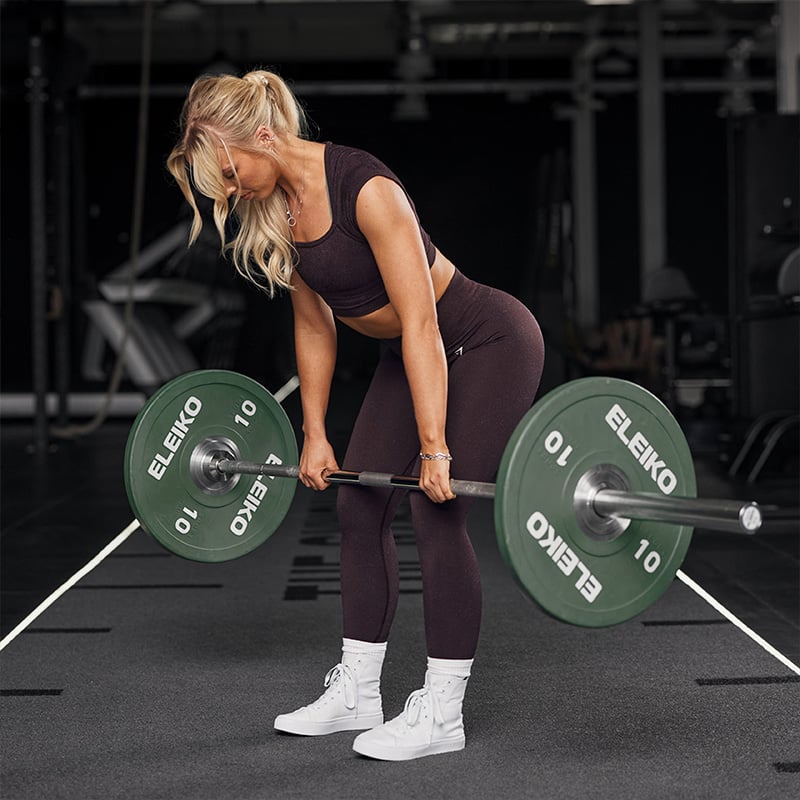
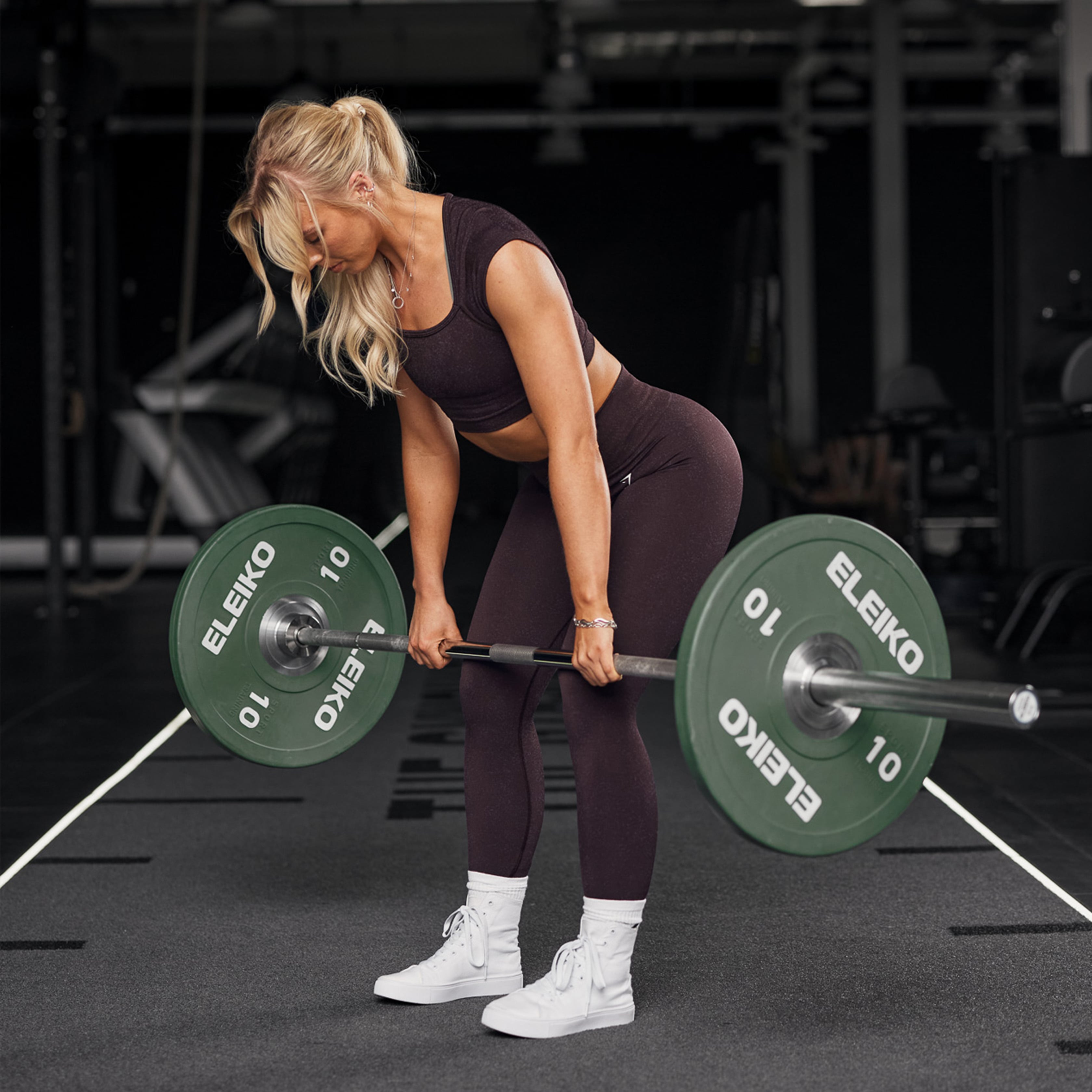
Romanian Deadlift form? Here are the best coaching cues on how to do the Romanian Deadlift:
Grab the bar just outside your hips with your feet around hip width [2].
Imagine you have apples in your armpits and you can’t let them fall out.
Slide your hips back and up whilst only letting your knees bend slightly.
Allow the bar to glide down your thighs and your shoulders come over your toes.
The bar will typically finish around the middle of your shins.
Romanian Deadlift Form Tips
Set your bar up in a squat rack. You don't need to lift the bar off the floor. We're RDL'ing, not deadlifting here. Put the barbell on the squat rack at thigh level so you don't have to bend too far to grab it.
Keep your lower back and glutes stable. Don't completely relax your lower back as you hinge. Instead, create enough tension to keep your torso stable while keeping your arms relaxed. Think about keeping your posterior chain engaged throughout the movement.
Focus on feeling your hamstrings. If you're struggling to feel them, try reducing the weight and focus on controlling the movement. Sam Sulek says it took him around two years to really feel his hamstrings working during RDLs, and that using lighter weights helped him understand the movement.
Use straps if your grip is limiting you. Sam uses straps when doing RDLs because he doesn't want his forearm strength to limit his hamstring training. If your grip gives out before your hamstrings, straps can help you keep the focus where you want it.
How Heavy Should You Go On Romanian Deadlifts?
You don't always need to go as heavy as possible on the RDL. The right weight depends on your goal and, more importantly, whether you can keep the tension where you want it.
Sam Sulek takes a deliberately lighter approach when his goal is to target his hamstrings fully. He says that although he likes training heavy, he avoids chasing maximum loads on RDLs to keep the movement focused on his hamstrings rather than letting his lower back and glutes take over.
I'm doing like half of what I could maybe do weight-wise, so that I can really squeeze it.
For Sam, the key is knowing when the hamstrings are no longer doing most of the work. If he reaches a point where he can continue the set but starts feeling his lower back and glutes taking over, he stops the set rather than adding more reps.
Just 'cause I can do more doesn't mean I'm working my hamstrings anymore.
This is also why ego lifting can be counterproductive on RDLs. Adding more weight isn't necessarily better if you can't control the movement and if your position gets worse, even more if you don't recruit the muscle you're trying to train. Choose a load that allows you to maintain your technique and feel your hamstrings working throughout the set.
4 Romanian Deadlift (RDL) Variations
Now, we know Romanian deadlifts are a useful exercise no matter your fitness goals. So, how can we mix it up a little without neglecting the fundamental movement and the benefits of the RDL?
Enter, Romanian deadlift variations. Here are 4 RDL variations to keep things fresh in your training program:
B Stance RDL
Rear Foot Elevated RDL
Single Leg RDL
Trap Bar RDL
1. B Stance RDL
This variation might just spice things up for you a little bit. You step one foot back so your toes are roughly in line with the back of your front foot. Lift the heel up of your back foot so it’s light, loose, and relaxed with a bent knee.
Most of your weight will be on your front leg as you lift. This allows for a bit more individual work for each leg, but still with a good amount of stability to get some weight on the bar. The only thing to consider is that you have to do both legs, which is not forgiving on your grip!
2. Rear Foot Elevated RDL
This just takes the B stance RDL and adds a bit more zing & pep (if you have seen The Office US you know). You simply elevate the rear foot up on a bench or box. Essentially, a Bulgarian RDL.
Try to keep the height of your hips even when doing this, so one side doesn’t drop down more than the other.
The benefit of this variation is that you will get even more individual work for each leg, with less support from the rear foot.
3. Single-leg RDL
This is your lowest stability RDL variation. This means it’s hard to balance, so it’s hard to load up and apply high force through the hamstrings and glutes to develop strength and size. However, for the force you lose, you gain the benefit of improving stability around the hip, knee, and ankle joints.
If you’re going to expose and imprrove any asymmetries, it will likely be with this unilateral variation. This is an RDL variation I quite like to use with Dumbbells. You can opt for holding one dumbbell in the hand opposite to the leg you’re working (allows you to hold onto something with the other hand for balance if needed), a dumbbell in each hand or a barbell.
Rather than focusing on the hips, I imagine that I have to push my bedroom door shut with my non-working leg and that I have to keep my toes pointing to the floor.
4. Trap Bar RDL
Adding a bit of spice (and zing, and pep) to the Barbell RDL, you can switch things up with a trap bar.
Be mindful that it’s harder to keep your knees slightly bent in this variation as you don’t have the bar sliding down your legs for feedback. However, if you feel your RDL technique is well ingrained, this can be a great variation to load RDLs up in a different way than using a regular barbell.
Because the load is at your sides and stays closer to your hips as you hinge down, this Romanian deadlift variation will likely be less demanding on your lower back, allowing you to load up and feel it on the hamstrings and glutes.
RDLs Alternatives
Good Mornings
If you want a Romanian Deadlift alternative, then the Good Morning is a good option. The only real difference here is that the bar is on your shoulders in a Good Morning instead of in your hands, so you can’t load a Good Morning up as much. Your lower back will likely fail before your hamstrings or glutes.
Back Extensions
If you want to train your posterior chain without doing RDLs, back extensions are a great alternative. They build your hamstrings, glutes, and lower back using that same hip-hinge pattern. Whether you use a GHD or a standard back extension machine (Roman chair), it is a great option if your lower back is already fatigued from heavy lifts. Keep in mind that machine choice slightly shifts the focus: the GHD recruits more glutes and lower back, while the Roman chair places heavier emphasis on your hamstrings.
Hamstring Curls
If you struggle to feel your hamstrings during RDLs, try a hamstring curl first. Because the hamstrings are the main muscles moving the weight, leg curls can make it easier to learn what a strong hamstring contraction feels like. Sam Sulek recommends using that same squeezing sensation as a reference when you return to RDLs.
Maybe by trying to work on how well you can isolate your hamstrings on a curl, try to keep that squeezing feeling in mind when you do the RDLS.
If you still can't feel your hamstrings during an RDL, don't assume you're doing it wrong. "It could just be a time thing," as Sam says. Developing a strong mind-muscle connection can take practice, and the movement may eventually click as you become more familiar with controlling the right muscles.
How To Program Romanian Deadlifts?
Romanian deadlifts don't have to be the only hamstring exercise in your workout. They can be combined with exercises such as seated or lying hamstring curls, with the order depending on your goals and how you want to structure your session.
Sam Sulek varies the order of these exercises in his own training. He may start with RDLs and use a heavier load, or finish with them and use a lighter weight with more focus on squeezing the hamstrings.
He also changes his approach depending on his training phase. When he's eating in a calorie surplus and focused on growing, he includes RDLs alongside hamstring curls. When dieting, he says he relies more heavily on hamstring curls instead.
References
Delgado, J., Drinkwater, E.J., Banyard, H.G., Haff, G.G. and Nosaka, K., 2019. Comparison between back squat, Romanian deadlift, and barbell hip thrust for leg and hip muscle activities during hip extension. The Journal of Strength & Conditioning Research, 33 (10), pp.2595-2601.
Frounfelter, G., 2000. Teaching the Romanian deadlift. Strength & Conditioning Journal, 22 (2), p.55.