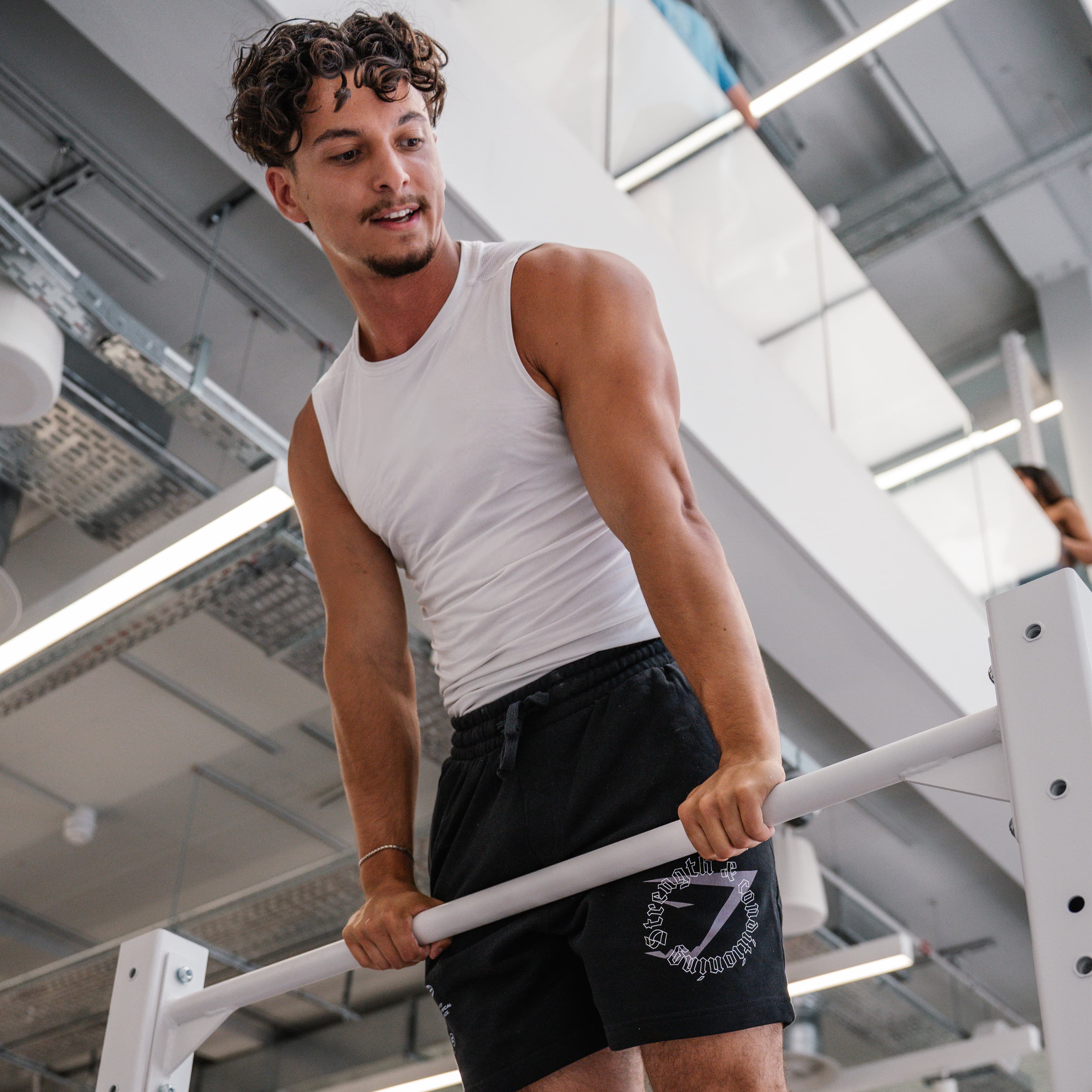







Hybrid training is the way to train–you only need to look at the rig on Richard Harris or Aimee Cringle’s shoulders to know that cardio and weights can produce jaw-dropping results.
But with that brings back one of the most asked questions in fitness: ‘Should you do cardio before or after weights?’
If you’re new to mixing strength and cardio, how to program your sessions for optimal results can be confusing.
Even if you’ve been concurrent training for a while (by which we mean combining resistance training and cardio within one program), there’s a fine line between structuring your sessions right and structuring them wrong–the latter risking overtraining, fatigue, and lack of progress.
So, if you’re searching for the real answer on how to combine cardio and strength in your program in an effective, efficient, and safe way, then we’ve got the answer. With help from the Gymshark Lifting Club Coach and Personal Trainer, Zachary Watson, we will answer if you should be doing cardio or weights first and how to effectively combine the two.
The Expert: Zachary Watson: Personal Trainer And Strength And Conditioning Coach at the Gymshark Lifting Club.
Should You Do Cardio Before Or After Weights?
If you want to combine cardio and strength training in one session, then you might be wondering whether you should do cardio or weights first. As a general rule of thumb, you should do cardio after weights.
Why? Because:
Lifting is hard: You need all the energy you can get to shift loads efficiently and with proper form. Would you feel confident that you could perform your best at squats after being out on a run? Probably not. And a study in The Journal Of Strength And Conditioning Research proved just that [1].
Lifting carries a higher risk of injury: Whether it’s barbells, dumbbells, kettlebells, or more, lifting (generally) carries a higher risk of injury than cardio. Pre-fatiguing your muscles with cardio before strength training could make you more susceptible to injury.
Lifting first will help you maximize strength gains (and lose more fat). Numerous studies have proven that resistance training before cardio improves muscle strength and power and that leaving your cardio until after your resistance training burns more fat [2].
@wilsoncoaching Cardio before or after weights? @gymshark c0d3 "SHIV10" 🦈 #wilsoncoaching #gymtok #gymtiktok #fitness #gym ♬ original sound - Shiv Wilson
Should Cardio Ever Come Before Weights?
Some rules are made to be broken–and the cardio or lifting first debate is no different. Here are some exceptions where you might do cardio before lifting.
1. If Your Main Goal Is Improving Endurance And Stamina (For Example, If You’re Training For A Marathon)
Lifting weights before your cardio has been found to reduce power, speed, and stamina–as well as running performance [3,4].
Prioritize your cardio, and you’ll have more energy to push harder, challenging your muscles to resist fatigue–therefore boosting your endurance.
Endurance training is also a modality we highly recommend dedicating a day to (rather than adding in any other strength or cardio, for that matter). Endurance training (particularly running) is a form of cardio that has been found to negatively affect strength training and requires significant energy expenditure to meet the requirements of prolonged activity [5]. For this reason, you should prioritize recovery following an endurance workout.
2. If You’re Warming Up
For many, jumping on a piece of cardio kit to start their workout feels almost subconscious. In fact, it is often recommended to do a short amount of cardio during a warm-up to get the blood flowing through your muscles, elevate your heart rate, and warm the muscles and joints.
This shouldn’t be anything strenuous–just 5 to 10 minutes of light work.
3. If You’re Doing A Session That Purposefully Combines Strength And Cardio
From a HIIT class to a Hyrox workout, some sessions purposefully combine strength and cardio. One minute you might be doing burpees, the next you’re hitting the deck for press ups, before smashing out a set of wall balls.
These types of workouts mainly build muscular endurance (even though you are lifting weights) because they generally keep the rep ranges higher and weights lighter, using dumbbells or kettlebells.
(We don’t know about you, but we get pretty sweaty during a HIIT class–a moisture wicking tshirt could be just what you need: Discover why we think moisture wicking tshirts are essential and our top 10 picks.)
Is It Ok To Do Cardio And Strength Training On The Same Day?
In short, yes. However, Gymshark Lifting Club coach Zach Watson recommends that for training cardio and strength on the same day:
‘Ideally, if you have time, you should split your cardio and weight training sessions, leaving 4 to 6 hours between workouts.’
This allows for better recovery between each exercise type, maximizes performance during both disciplines, and reduces the likelihood of the ‘interference effect’ (which traditionally believed that strength and hypertrophy gains would be significantly diminished by performing cardio and strength in one session) [6].
These sessions don’t have to be as long–you could do two shorter workouts, e.g., 2x45-minute sessions.
‘However, I wouldn’t recommend doing two intense sessions in a day’, says Zach. ‘Balance your sessions with one higher intensity workout and one lower intensity, such as an interval run, and then light accessory work later e.g. ab training and calf exercises.’
What If You Don’t Have Time To Train Twice A Day?
Many of us don’t have time to train twice a day–or simply don’t want to! In this case, you can train cardio and weights together.
Recent research has proved that the interference effect is, at most, only small. A 2022 study proved that concurrent aerobic and strength training did not impair the development of maximal strength or muscle hypertrophy [7].
Some research shows some health benefits to doing cardio and resistance training in one session, including lower risk of mortality. So if you have to train both together in one session, you absolutely can–but you should follow the tips below to ensure you do it safely [8,9]!
Tips From A Coach On How To Balance Strength And Cardio In One Session
Always Prioritise One Thing Per Session (Or Day)
Whether it’s Olympic lifting, running, or strength training, pick one discipline per session as your priority. This will likely be the first thing you do–and whatever follows that should be at a lower intensity. Consider your overall goal, which will help you determine what to prioritize.
Balance Volume And Intensity
Doing 40 minutes of intense lifting followed by 20 minutes of intervals might feel fine for one day. But with greater intensity comes the need for greater recovery time–risking jeopardizing the rest of your week.
Be conscious of how much work you put into one session, and balance intensity accordingly. If you’re doing heavy lifting or Olympic weightlifting, end your session with an easy run or light circuit–balancing periods of high-intensity work with a lighter intensity. Don’t do too much in one session.
This applies to double training days, too: If you train twice a day, don’t make both sessions high-intensity. For example, mix your easy run with your strength session rather than doing interval training and a heavy strength session in one day.
Always Allow Enough Time For Recovery
We know by now that rest days are not for the weak. Everyone needs recovery, but how much we actually need can differ greatly. The American College of Sports Medicine advises leaving at least 48 hours between resistance training sessions for major muscle groups. This could mean a complete rest day or a lower-intensity session, e.g., focusing on stretching/mobility or an easy run or cardio. Listen to your body and give yourself enough recovery between two sessions.
Recovery can also apply within sessions: It’s okay to take a 5—or 10-minute break within your session if you feel you need it when switching between strength and cardio.
If you’re doing a double session, try to leave at least 4 to 6 hours between sessions.
Don’t Do Too Much Too Soon
If you’re writing your own program, keep the volume low to start with, and see how your recovery is. Not only does this make it easier to stick to your plan, but it means you’ll avoid doing too much too soon and hindering progress.
Start light with a few exercises, then add in extra sets and increase the weight, distance, or time as you progress. Be conscious of monitoring your recovery, sleep, and how your body feels after each session.
How Often Should You Do Cardio And Weight Training?
ACE recommends a minimum of 150 minutes of moderate-intensity aerobic exercise or 75 minutes of vigorous exercise per week, combined with strength training for each major muscle group twice weekly. However, the required frequency is likely to be significantly higher for those who have been training for a while.
Strength Training
Research suggests that for strength gains, more frequent resistance training was found to better:
A 2023 study concluded that three days a week of strength training was superior to two days a week when measuring bicep strength [10].
Previous research from the same researchers found that those exercising five days a week had greater strength improvements (by more than 10%) compared to the group that only trained three days a week, suggesting that higher–frequency training is better for strength gains [11].
Cardio
When it comes to cardio, there isn’t a set number of days you should work out, but some research concludes prolonged exercise sessions are better. Short bursts of exercise (or ‘exercise snacks’) are also effective where long sessions aren't possible.
Combining The Two
Combining cardio and weight training into one session is a time-efficient way to work towards both goals. However, as mentioned above, you need to be conscious of the intensity of your sessions and overall weekly volume. Pair easier cardio with heavier weight sessions and more intense cardio with a lighter strength session.
If you’re performing a longer stint of cardio, e.g., a long run, you should consider performing this on a separate day from any other training modalities. This form of training requires prolonged muscle activation, leading to significant energy expenditure, which could impact strength gains and requires adequate rest and nutrition to recover from.
Interested in learning more? Discover how often you should go to the gym–and if you can work out daily.
In Summary
If you want to combine strength and cardio in your workout split, you absolutely can. In an ideal world, you would split the two disciplines into two separate sessions within the day, leaving 4 to 6 hours between each to optimize recovery and performance for each session.
But for many of us, it just isn’t feasible. In this case, you can combine strength and cardio in one session and get good results.
Generally, you should prioritize resistance training (and save cardio for the second half of your session).
The only exception is if you are training primarily for endurance, in which case lifting weights prior to a longer cardio session may fatigue the body and impact how hard you can push yourself.
When balancing cardio and strength, the most important thing is to manage your weekly volume and intensity by not making each session too hard. Don’t program too much too soon, and give ample time for recovery between sessions.
References:
Panissa, V.L.G., Tricoli, V.A.A., Julio, U.F., Ribeiro, N., de Azevedo Neto, R.M.A., Carmo, E.C. and Franchini, E. (2015). Acute Effect of High-Intensity Aerobic Exercise Performed on Treadmill and Cycle Ergometer on Strength Performance.
GOTO, K., ISHII, N., SUGIHARA, S., YOSHIOKA, T. and TAKAMATSU, K. (2007). Effects of Resistance Exercise on Lipolysis during Subsequent Submaximal Exercise.
Conceição, M., Cadore, E.L., González-Izal, M., Izquierdo, M., Liedtke, G.V., Wilhelm, E.N., Pinto, R.S., Reistenbach Goltz, F., Dornelles Schneider, C., Ferrari, R., Bottaro, M. and Kruel, L.F.M. (2014). Strength Training Prior to Endurance Exercise: Impact on the Neuromuscular System, Endurance Performance and Cardiorespiratory Responses.
Doma, K. and Deakin, G.B. (2013). The effects of strength training and endurance training order on running economy and performance.
www.acefitness.org. (2017). Cardio or Weights First? Cardio Before vs. After Lifting. [online] Available at: https://www.acefitness.org/resources/pros/expert-articles/6228/cardio-or-weights-first-cardio-before-vs-after-lifting/.
Hickson, R.C. (1980). Interference of strength development by simultaneously training for strength and endurance.
Schumann, M., Feuerbacher, J.F., Sünkeler, M., Freitag, N., Rønnestad, B.R., Doma, K. and Lundberg, T.R. (2021). Compatibility of Concurrent Aerobic and Strength Training for Skeletal Muscle Size and Function: An Updated Systematic Review and Meta-Analysis.
Schroeder, E.C., Franke, W.D., Sharp, R.L. and Lee, D. (2019). Comparative effectiveness of aerobic, resistance, and combined training on cardiovascular disease risk factors: A randomized controlled trial.
Coleman, C.J., McDonough, D.J., Pope, Z.C. and Pope, C.A. (2022). Dose–response association of aerobic and muscle-strengthening physical activity with mortality: a national cohort study of 416 420 US adults.
Yoshida, R., Sato, S., Kasahara, K., Murakami, Y., Murakoshi, F., Aizawa, K., Koizumi, R., Nosaka, K. and Nakamura, M. (2022). Greater effects by performing a small number of eccentric contractions daily than a larger number of them once a week.
Yoshida, R., Sato, S., Kasahara, K., Murakami, Y., Murakoshi, F., Aizawa, K., Koizumi, R., Nosaka, K. and Nakamura, M. (2022). Greater effects by performing a small number of eccentric contractions daily than a larger number of them once a week.