

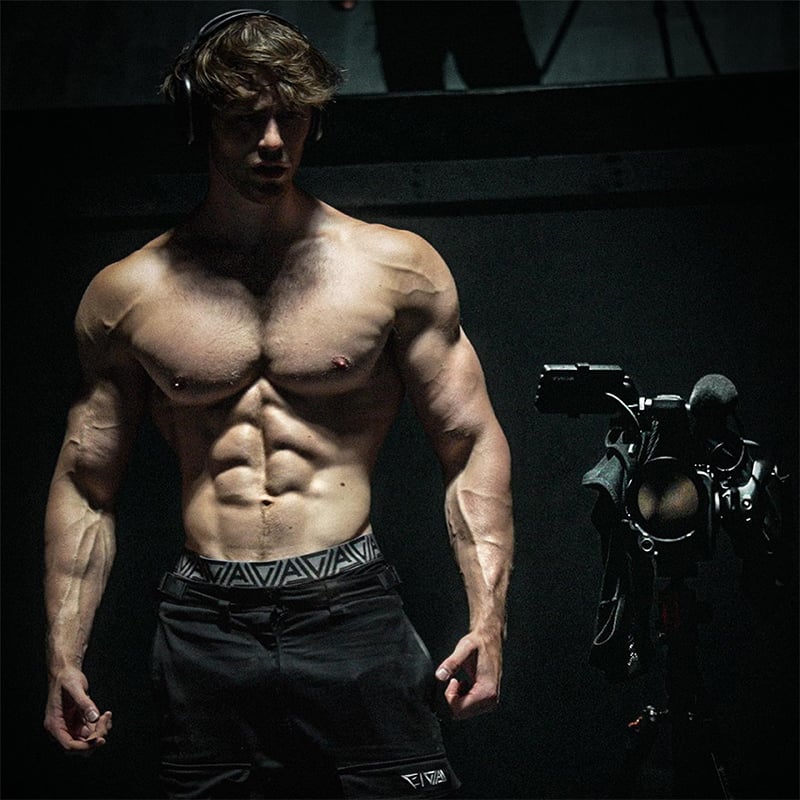
If you’ve spent any time on fitness YouTube over the last decade, chances are you’ve come across David Laid.
Known for his towering frame, wide shoulders, and trademark tiny waist, David became one of the defining faces of modern powerlifting. His training style blends hypertrophy-focused bodybuilding with strength-driven powerlifting, following a hybrid approach known as powerbuilding that has helped him build both an impressive physique and serious strength numbers in the gym.
From heavy deadlifts to high-volume accessory work, David’s workouts revolve around progressive overload, compound lifts, and strategic muscle-building work, all designed to build that classic V-taper aesthetic.
It’s his combination of strength and physique that has motivated many to start powerbuilding themselves.
Powerbuilding is a training method that combines powerlifting and bodybuilding. The goal is to increase strength on big compound lifts like the squat, bench press, and deadlift while also using higher-volume accessory work to build a well-rounded physique.
For many lifters, it offers the best of both worlds. Traditional strength training can improve strength, but doesn’t always build the physique you’re chasing. While bodybuilding focuses purely on aesthetics and on competitors being strong, it overlooks training for athletic output, functional capacity, and mobility.
Powerbuilding sits right in the sweet spot between the two. If you want to get functionally strong, keep training exciting, and enjoy the challenge of heavy barbell lifts while also working toward a muscular and aesthetic physique, you might just want to start following this split.
Here’s a breakdown of David Laid’s workout routine, favourite exercises, training principles, and how you can apply them to your own training.
What Is David Laid’s Workout Routine?
David Laid’s training style is rooted in powerbuilding: a hybrid approach that combines:
Heavy strength-focused compound lifts
Higher-volume hypertrophy work
Progressive overload
Aesthetic-focused accessory training
Over the years, he’s also spoken about using Daily Undulating Periodization (DUP) in his programming. David Laid’s DUP program is one of the biggest reasons his training style became so influential online.
What is DUP?
“Daily: it happens on a day-to-day basis.
“Undulating: meaning it changes.
“Periodization: is your systemic programming,” David explains in a 2018 YouTube Video [1].
Rather than sticking to the same sets and reps every workout, DUP rotates intensity and training volume across the week to develop both strength and hypertrophy simultaneously.
This means you might bench heavy for low reps earlier in the week, then return later for higher-volume hypertrophy work using lighter loads and more controlled tempo.
As David explains in his own training philosophy:
“I’m a strong believer in programming which prioritises strength in the development of one’s physique [2].”
He also describes strength progression as “the natural lifter’s most valuable tool” for building muscle and reaching genetic potential [2].
This philosophy sits at the centre of powerbuilding: using strength progression to support long-term muscle growth rather than treating aesthetics and performance as separate goals.
For example:
One session may focus on strength (3 to 5 reps)
Another on hypertrophy (8 to 12 reps)
Another on power or speed work
The goal? Build muscle and continue progressing on the big lifts without plateauing.
A typical David Laid-inspired DUP powerbuilding split could look something like this (more on reps and exercises below):
Day: Focus
Monday: Push (strength focus)
Tuesday: Pull (hypertrophy focus)
Wednesday: Legs (hypertrophy + strength)
Thursday: Rest or active recovery
Friday: Upper body (volume focus)
Saturday: Lower body (posterior chain focus)
Sunday: Rest
This style of training works particularly well for lifters who:
Find pure bodybuilding boring and want to switch up their training more
Still care heavily about aesthetics but want to build muscle without sacrificing strength
Want to recover better between heavy sessions
Love chasing PRs and keeping training performance-driven
Want to avoid plateauing on compound lifts
David Laid Workout Plan
David Laid’s training is commonly associated with a 6-day DUP powerbuilding split, rotating between legs, push, and pull sessions twice per week.
Rather than keeping the same intensity every workout, the program changes rep ranges and loading throughout the week. Heavy low-rep work is paired with higher-volume hypertrophy sessions to develop both strength and muscle simultaneously.
DUP Split
Legs 1
Goal: Squat strength and lower-body hypertrophy
Squat: 5RM effort
Back squat: 4 × 12
Romanian deadlift: 3 × 10
Walking lunges: 3 × 10 each leg
Glute ham raise or reverse hyper: 3 × 10
Push 1
Goal: Heavy pressing strength
Bench press: 1RM effort
Bench press: 4 × 4
Push press: 3 × 4
Weighted dips: 3 × 10
Dumbbell flyes or pec deck: 3 × 10
Dumbbell lateral raises: 3 × 10
Skull crushers: 3 × 10
Dumbbell tricep extensions: 3 × 10
Pull 1
Goal: Deadlift strength and posterior-chain development
Deadlift: 3RM effort
Deadlift: 4 × 6
Stiff-leg deadlift: 3 × 10
Pull-ups: 3 × 8 to 10
Yates row: 3 × 10
Shrugs: 3 × 10
Barbell curls: 3 × 10
Seated hammer curls: 3 × 10
Legs 2
Goal: Moderate-intensity squat work with hypertrophy volume
Squat: 3RM effort
Back squat: 4 × 8
Romanian deadlift: 3 × 10
Walking lunges: 3 × 10 each leg
Glute ham raise or reverse hyper: 3 × 10
Push 2
Goal: Shoulder development and overhead pressing strength
Overhead press: 5RM effort
Overhead press: 4 × 12
Barbell incline bench: 3 × 12
Dumbbell lateral raises: 3 × 10
Weighted dips: 3 × 10
Dumbbell tricep extensions: 3 × 10
Skull crushers: 3 × 10
Pull 2
Goal: Heavy posterior-chain work and back hypertrophy
Deadlift: 1RM effort
Deadlift: 4 × 2
Stiff-leg deadlift: 3 × 10
Pull-ups: 3 × 8 to 10
Yates row: 3 × 10
Shrugs: 3 × 10
Barbell curls: 3 × 10
Seated hammer curls: 3 × 10
Across the program, rep ranges rotate between 1RM, 3RM, and 5RM work, alongside higher-volume hypertrophy sets, creating the undulating structure that defines DUP training.
David Laid’s Top 10 Muscle-Building Exercises
David Laid prioritises his big lifts as much as his isolation work and back mobility. Heavy compounds like squats, bench press, deadlifts, and pull-ups build the foundation, while movements such as lateral raises, curls, and pushdowns help create the shoulder width, back development, and arm size associated with his look.
Below are some of the exercises David Laid couldn't live without and how they contribute to building a powerbuilding physique.
1. Squats
If there’s one movement synonymous with powerbuilding, it’s the barbell squat.
David Laid regularly incorporates heavy back squats into his training to build:
Heavy squats also create huge systemic fatigue, which can help drive overall muscle growth when paired with proper recovery and nutrition.
For hypertrophy-focused sets, most lifters benefit from working in the 6 to 10 rep range. For strength development, lower rep ranges are typically used.
2. Bench Press
The bench press is another staple in David’s routine and a core movement in most powerbuilding programs.
The bench develops:
But beyond aesthetics, it’s also one of the clearest exercises to track upper-body strength progression over time.
A lot of powerbuilders structure their week around improving their squat, bench, and deadlift numbers while using accessory movements like lateral raises, incline presses, bicep curls, and Romanian deadlifts to target smaller muscle groups that need isolation for optimal growth.
3. Deadlifts
Deadlifts are one of the biggest strength-builders in any training program, but especially David Laid’s. At just 19, he achieved a 306kg deadlift, an elite feat of strength for his age and weight class. He continues to document his heavy deadlifts, which contribute to his thick posterior chain and athletic look.
Deadlifts train:
Glutes
Spinal erectors
Deadlifts also develop full-body tension and force production - basically, your ability to stay tight and generate power through multiple muscle groups at once. That skill doesn’t stay isolated to deadlifts either; it carries over into squats, rows, and other heavy compound lifts where stability and bracing make a big difference to performance.
4. Pull Ups
Pull-ups are key for building the back width and upper-body shape many people associate with David Laid’s physique, and he highlighted them as one of his must-have exercises for hitting back [3]. A strong back creates the illusion of a smaller waist, helping build that sought-after V taper. Pull-ups also represent a core marker of bodyweight strength, where controlling and lifting your own mass reflects real, functional strength, not just gym numbers.
Pull-ups primarily target:
Lats
Upper back
Biceps
Weighted pull-ups are particularly popular in powerbuilding because they allow continued progressive overload once bodyweight reps become too easy.
5. Bicep Curl
While compounds are the foundation of powerbuilding, accessory movements still matter… a lot.
That’s one of the biggest misconceptions around powerbuilding: people think it’s just strength training plus a few curls and dips. In reality, the accessory work is often pushed just as hard as the compounds, and that’s why physiques can become so defined.
Barbell curls help build:
Biceps size
Arm thickness
Pulling strength carryover
If aesthetics are the goal, then you’ll know how much training arms in isolation really matters.
6. Dips
Dips are a powerhouse movement for chest, shoulders, and triceps. They’re basically “a floating push-up” as Davids describes, emphasising how they train multiple upper-body muscle groups at once [3].
They can also be adapted. Small changes in technique shift the emphasis onto different muscle groups:
A slight forward lean places more load through the chest
A more upright torso increases triceps demand
This makes dips a highly adaptable movement depending on your goal, whether that’s chest development or triceps strength.
Weighted dips are commonly used in advanced powerbuilding routines because they allow for a progressive overload approach to a bodyweight exercise. As load increases over time, they build both pressing strength and upper body size in a way that carries over directly into bench press performance.
7. Lateral Raises
You can’t really talk about aesthetic physiques without mentioning side delts.
Shoulder development is another area David prioritises, quickly naming “lateral raises” when asked which movements he’d keep for building muscle [3].
Lateral raises target the medial deltoids, helping create broader-looking shoulders and enhancing the shoulder-to-waist ratio. It’s this emphasis on shoulder width that gives physiques that dramatic “superhero silhouette” effect associated with David Laid.
And because lateral raises are an isolation movement, they respond best to higher-rep, controlled training rather than heavy loading. We’d recommend doing:
12 to 20 reps per set
Controlled tempo with minimal momentum
High time under tension
This approach maximises mechanical stress on the delts without turning the movement into a swing-based compensation exercise.
8. Back Hyperextensions
Back hyperextensions are underrated in physique-focused training, but they play an important role in building a well-developed posterior chain. David has also spoken positively about this movement for back support, particularly as someone managing back problems himself [3].
He includes variations of hyperextensions to strengthen:
Lower back (spinal erectors)
Glutes
Hamstrings
When you strengthen these muscles, you also reinforce hip extension strength, which is a key movement pattern used in deadlifts, squats, and other heavy compound lifts.
Beyond muscle development, hyperextensions also improve spinal endurance and lower-back resilience, helping you maintain better positioning under fatigue. This support work carries over into heavier training sessions where bracing and control become just as important as raw strength.
9. Tricep Pushdown
Tricep pushdowns were one of the exercises David included when discussing the movements he’d keep if limited to only ten exercises for building muscle.
While compound presses like the bench press, overhead press, and dips already train the triceps, isolation work helps increase volume and bring up arm development.
Tricep pushdowns primarily target:
Triceps
Elbow extension strength
Bench press lockout support
David specifically mentioned cable pushdowns, highlighting them as one of his go-to arm exercises [3].
Pushdowns are particularly useful in powerbuilding because they add hypertrophy work without creating the same fatigue as heavy pressing movements. Most lifters respond well to:
10 to 15 reps
Controlled tempo
Full extension at lockout
You’ll isolate your triceps and build that rounded arm shape without blowing out on compound lifts.
10. Bird-Dogs
Bird dogs might seem like an unexpected addition in a powerbuilding routine, but David included them when discussing exercises he’d keep long term, especially for supporting back health [3].
Bird dogs primarily help train:
Core stability
Lower back endurance
Glutes
Spinal control
Unlike heavy compounds, bird dogs aren’t designed to build maximal strength or muscle. Instead, they help improve coordination, stability, and control through the trunk and hips.
David also highlighted the importance of lower-back support movements alongside hyperextensions:
For lifters running high-volume powerbuilding programs with frequent squats and deadlifts, lower-back fatigue can accumulate quickly. Including stability work like bird dogs may help reinforce bracing mechanics and improve movement quality.
Typical programming might include bird-dogs a few times a week with:
2 to 3 sets
8 to 12 reps per side
Slow, controlled movement
Focus on keeping the torso stable throughout
Is It Possible To Get a Physique Like David Laid?
The honest answer is that you can try. And depending on your training and genetics, you might get somewhere close.
You can absolutely build a stronger, more muscular, leaner physique using the same principles David Laid trains with. But genetics, limb length, muscle insertions, frame size, and consistency all play a role in how someone ultimately looks, and David Laid has a particularly unique physique that is strong in all these areas.
Rather than trying to look exactly like David Laid, a better option is:
Use his training principles
Apply them consistently
Build the best version of your physique
Because the real takeaway from David Laid’s approach isn’t “train exactly like him.” It’s understanding why his training works.
David Laid’s Training Tips
1. Treat Accessory Lifts Seriously
One of the biggest mistakes people make in powerbuilding is only caring about the big three.
Yes, compounds matter. But your accessory work is often what shapes your physique.
Your rows, curls, lateral raises, tricep work, and pull-ups deserve effort and progression, too.
2. Use Progressive Overload
Muscle growth rarely happens from randomly changing exercises every week. To get better at something, you have to keep at it. This is fundamentally what progressive overload is. Think the same exercises, week in week out, until you see progress.
Over 4-8 weeks, make sure to track:
Weight
Reps
Sets
Performance trends
Over time, gradual progression creates gradual transformation.
3. Don’t Ignore Time Under Tension
You don’t always need heavier weights to make an exercise harder. Controlling the lowering phase of each rep increases muscular tension, helping stimulate more growth while improving technique and execution.
E.g: In a bicep curl, the eccentric is lowering the dumbbell back down.
For hypertrophy-focused accessory work:
Slow the lowering phase
Avoid rushing reps
Keep tension on the target muscle
Focus on the muscle, improving the
4. Eat According To Your Goal
Training is only part of the equation. Your nutrition needs to support your goal too, whether that’s building size, improving strength, or getting leaner while maintaining muscle.
If your goal is size:
Eat in a calorie surplus
Prioritise protein
Recover properly (rest + sleep)
If your goal is to get leaner:
Maintain high protein intake
Use a moderate calorie deficit (300-500 calories less is sustainable)
Keep your training performance output high
FAQs
How Many Days Do I Need To Train To Get David Laid’s Physique?
Most powerbuilding programs involve training 4 to 6 days per week, depending on recovery, experience, and overall volume.
Consistency over time matters more than copying an exact split. Make sure you’re showing up, dialing in your nutrition, and working hard.
What Is David Laid’s DUP Program?
David Laid’s training is heavily associated with Daily Undulating Periodization (DUP), a programming style that changes rep ranges and intensity throughout the week.
Instead of performing the same style of training every session, DUP alternates between:
Strength-focused workouts
Hypertrophy-focused workouts
Higher-volume accessory sessions
This allows lifters to progressively overload compound lifts while still accumulating enough training volume for muscle growth, making it one of the most popular approaches in powerbuilding programs.
Is Powerbuilding Effective?
Yes, this training style is especially effective for people who want both:
Strength progression
Aesthetic muscle growth
Powerbuilding combines the progressive overload focus of strength training with the volume needed for hypertrophy, making it an effective hybrid approach.
What Are the Differences Between Hypertrophy and Strength Training?
Hypertrophy is typically a more aesthetic-based training style, primarily focusing on increasing muscle size, by using:
Moderate weights (around 60–75% of your 1RM)
Moderate to high reps (6–12 reps per set, sometimes up to 15–20 for isolation work)
Higher overall training volume (more sets per muscle group)
Example:
4 sets of 8–12 reps on incline dumbbell press
3–4 sets of 10–15 reps on lateral raises
Strength training focuses more on maximal force production, usually involving:
Heavier loads (around 80–95% of your 1RM)
Lower reps (1–5 reps per set)
Longer rest periods (2–5 minutes to fully recover between sets)
Example:
5 sets of 3 reps on barbell bench press
4–6 sets of 2–4 reps on squats or deadlifts
Powerbuilding blends both styles together.
Can You Grow Muscle and Get Strong Simultaneously?
Absolutely. In fact, that’s the entire premise of powerbuilding.
Building muscle can improve strength potential by increasing the amount of muscle available to produce force, while strength-focused training helps improve neural efficiency and lifting performance.
For many intermediate lifters, combining both approaches creates the best balance of performance and aesthetics.
References: