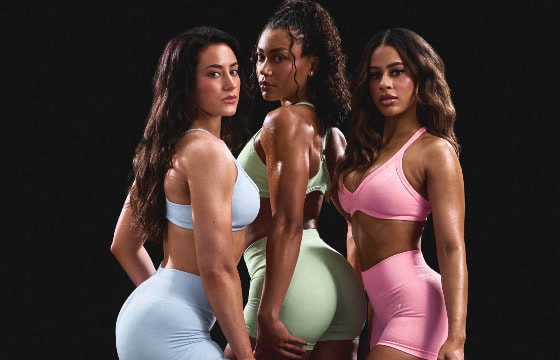


There’s no time to waste wearing the wrong sports bra. Our sports bras should have our back, support us in times of need, and boost us up, bare minimum. No matter the shape or size of your boobs, you can discover the perfect-fit sports bra with us. Our sports bras are designed to keep your breasts supported properly during whatever activity you do, be that RDLs and your interval runs, and we know every pair has their own requirements.
From strappy back bras that give minimal support but maximum style, to supportive high-impact bras to wear while running, we’ve got stylish sports bras for your every workout.
Find yours now.
Why The Right Sports Bra Is So Important
Finding the right type of sports bra has never been so easy. With stylish designs across the board, you can feel confident even in your high-support bras, which historically haven’t been all that pretty.
But it’s not all about looks, our sports bras serve a function, to feel comfortable, and support you, for every breast size and shape, and every workout.
So what are the benefits of wearing the right sports bra?
Wearing the right sports bra is important not only for the protection of your breasts but also for your athletic performance. Clothes can hinder us as much as they can support us, and comfort is a priority when it comes to our sports bras because wearing the wrong one can cause us issues we’d ideally like to avoid.
Why is wearing the right sports bra is so important?
Improve sports performance
Breast bounce can be at its worst, painful, and often distracting, so wearing the correct support bra can minimize chest movement, allowing you to concentrate on your training.
Help prevent breast tissue damage
Aside from your sports bra, your skin is the only thing supporting your boobs and keeping them up. Wearing the wrong sports bra can put a lot of strain on the breasts, causing tissue damage, and stretching the skin, which can cause irreversible damage to your girls and their perkiness.
Help alleviate discomfort
The right fitting sports bra can help eliminate experiencing soreness in your breasts, but it can also take away discomfort caused by tight straps digging in, or a too-tight or loose underband.
How To Find The Correct Size Sports Bra
So you know why the right sports bra is so important, now it’s time to make sure that you find the correct size sports bra for your workouts.
Unlike getting a traditional bra fitting, you can measure your accurate sports bra size at home through a series of three simple steps spelled out to us by our Senior Bra Developer, Nicki Hall.
You’ll need a non-padded and non-wired bra* and a flexible tape measure at hand.
The steps to find the correct size sports bra are as follows;
Measure your underbust
Measure your bust
Check your measurements against our sports bra size chart
For detailed instructions on how to measure your underbust and bust size, check out our sports bra sizing guide.
Once you’ve figured out your bra size, you’ll next need to figure out what support level you need in your sports bra. Yoga sports bras are very different from running sports bras, but luckily, in this article, you can find out what support level is best for you.
How about ensuring your existing sports bras fit correctly? Well, here’s how to check if they fit right;
Check the Straps - 20% of the support from your sports bra comes from the straps. You should be able to place a finger underneath your sports bra straps; loosen if you can’t, but don’t go too loose.
Evaluate the Tightness of the Underband - the underband should be sat firm at the top of your ribcage and stay in place if you lift your arms above your head. 80% of the support comes from the underband so if it’s too loose, size down.
Assess The Cup Size By Testing Out Exercise Movements - jiggle around in your sports bra to see whether your boobs sit comfortably, if they poke or bulge out at all, or if the cup feels too big or saggy and has any air pockets.
Should You Be Doubling Up Your Sports Bras?
If you’ve got a bigger bust, chances are you’ve thought to yourself, “Hmm, could doubling up give me more support ?”. It usually shows up mid-workout, like a run where there’s far too much bounce. Box jumps that make you instinctively cross your arms before you land, or even a warm-up that feels less comfortable than it should.
Maybe you’ve been wearing the same trusty sports bra for years, or maybe your body’s changed, along with your training. Either way, that search to get that level of support just right seems to keep creeping back in.
Well, you’re not alone; the doubling-up dilemma is a question that pops up in search bars and Reddit threads. Users are swapping hacks, debating whether to layer a sports bra over a regular sports bra, or wondering whether two bras is just what comes with the territory of having a bigger bust.
Because let’s face it, a high-impact workout can be a humbling reminder of the power of gravity, and it’s often the moment you start questioning how to get that extra chest support without sacrificing comfort.
So, should you actually be wearing two sports bras at once? Sometimes it’s okay, but it’s not generally recommended. Here we’re going to break down why, and what usually works better instead.
What doubling up actually does:
Doubling up means layering two sports bras for extra support, usually, with a compression-style sports bra underneath and another lighter support bra on the top to limit movement even more.
Why people might try it:
They want less bounce during high-impact training. If you’re sprinting, jumping, or doing anything fast and explosive, doubling up can reduce movement and help you feel more secure, and for some bust sizes, that added control can bring confidence to some.
If one sports bra feels almost supportive enough, but not quite. Doubling up can work in the meantime, but this is a sign to invest in a higher-support option.
If your sports bra doesn’t feel quite right, maybe it’s old, you’re in between sizes, or just making do with what’s in your drawer, layering can be a short-term workaround. It’s not a solution for the long run, but it can help you feel more secure and supported until you find a sports bra that truly fits your body and training.
That extra layer can feel more secure, especially for running, plyometrics, or HIIT, but it’s not the best long-term fix.
Why wearing two-sports bras might not be the best move:
Two sports bras can feel restrictive, not supportive
Sports bra support should feel secure and held-in, not like you’re fighting for air. Doubling up can shift too much pressure onto your shoulders, while the underband digs into your ribs. Instead of feeling supported, you end up feeling restricted, and that kind of discomfort isn’t a very smart trade-off just for a bit of extra hold.
It can increase chafing and discomfort
More layers mean more seams, more friction, and more heat. On longer runs or high-sweat sessions, that extra fabric can rub, shift, and trap moisture, causing discomfort, the complete opposite of what you want when you’re trying to stay focused on your workout.
It’s masking an issue with the fit
If you’re doubling up because one bra doesn’t feel supportive enough, the issue is usually fit or support level, not a lack of layers. A sports bra that’s too loose in the band, too stretchy for high-impact training, or not designed for your activity will always feel like it needs backup. Time for a refresh! Follow our sports bra fit guide for guidance on getting your perfect fit.
Doubling up can limit the range of motion
Two sports bras can restrict shoulder movement, especially during upper-body work, mobility sessions, or any overhead pressing. The extra layer can make you feel pulled forward or held back mid-movement, hindering your range of motion rather than supporting it.
The better alternative?
In most cases, one well-fitting sports bra with the right support level will do a better job than layering two together. Bra technology has come a long way, and today’s sports bras are designed to deliver the necessary support in a single layer. They use a mix of features like built-in cups, breathable fabrics, encapsulation, and compression to keep everything secure without upping the pressure.
If you’ve got a bigger bust, that usually means opting for high support across all activities. For smaller chests, medium to high support is advised to cover everything from strength training to cardio. And if you’re between sizes and are looking for more support out of your sports bra, keep an eye out for adjustable straps, hook-and-eye closures, or firmer bands - these features will usually give you more security than having to double up.
If you like a held-in, secure feel, look for higher-support bras that combine compression and encapsulation. They’re designed to firmly hold, sculpt, and reduce chest movement while still letting you breathe and move freely.
Thoughtfully designed for the task of supporting, one well-designed sports bra will always outperform two layered together.
What Are The Different Types Of Sports Bra Support Levels?
The three different types of sports bra support levels are;
Low-support
Medium-support
High-support
"But what style of sports bra is right for me?" It's one of the hardest questions within the boob-sphere. You know how your sports bra should fit, you understand the importance of its support, and by now, you're happy to call yourself a veteran of the all-important "bounce test"... but those are just the basics.
“Unknown to many, athletes may require the same amount of breast support during power walking as they do during sprinting, and a lack of support has the potential to cause irreversible damage.” – Professor Joana Wakefield-Scurr, Head of the Research Group in Breast Health.
The support level of your sports bra (available in light, medium, and high) is just as important as its fit. With a steady increase in women ditching the workout t-shirt altogether, believe us when we say that the search for a sports bra that is not only suitable for the type of activity we're doing but also happens to look good and make us feel confident is high.
Which sports bra support level is right for you comes down to three things:
The type of activity you'll be using the bra for - higher-impact activities require more support.
The size and shape of your breasts - large busts may need more support than smaller chests, even in lower-impact activities.
If your bust is soft or firm, softer busts may need more support from their sports bras day-to-day.
Our sports bras are available in three impact levels: high, medium, and low support, so whether you’re a runner, a yogi, or you consistently hit your 10k steps a day, you can find the right sports bra for all your activities.
Find out more about our sports bras below:
Support levels are completely subjective and, depending on your bra size and the firmness of your breasts, you might feel more comfortable in a high-support sports bra even when you’re doing low-impact exercises or running errands at the weekend. We’re just offering you a little insight as a guide. You know what's best!
Types Of Sports Bras
There are three main types of sports bras available: an encapsulating bra, meaning it is cup-sized, compression, which is alpha-sized (XS, S, M, etc.), or a combination bra, which is a hybrid of both styles.
Encapsulation
An encapsulation sports bra has two separate cups that support each breast individually, like a traditional bra. This is a more structured style of sports bra that usually features adjustable straps, back fastenings, and underwiring, and they are sized like your everyday bras using cup size and underband, such as 34C, or 36DD, for example. This type of sports bra is suitable for all cup sizes, especially larger chest sizes C and above, and is recommended for high-impact activities like HIIT and running.
Compression
A compression-fit sports bra provides all-around pressure to the chest area to secure the breasts and minimize movement. Your compression sports bras are usually a pullover kind and often feature a racerback design. They tend not to have adjustable straps and don’t have separate cups, but the centerpiece lies flat against your chest when on. This type of bra usually only offers medium support at most, so we tend to only recommend compression sports bras for running for those with a smaller bust size, aka a B cup or below.
Combination
Combination sports bras are a mixture of the encapsulation design that supports both breasts individually and the compressive design that compresses the breasts against the chest. The combination of these two qualities makes these hybrid bras a brilliant choice for those who need the most support. They offer the best support and comfort and are ideal for high-impact sports like running, and offer high support for all cup sizes across all activities.
What Are The Most Supportive Sports Bras?
The most supportive sports bras you can wear are high-support sports bras, as they are made for high-impact activities that require your boobs to be amply supported and protected. Finding the best support sports bra should be a priority, even if you have a smaller chest, as the breasts can move significantly during exercise, and wearing the wrong support bra can cause the skin to stretch considerably, which can lead to injured skin fibers.
So don’t be afraid to look for support when you need it the most.
High Support Sports Bras:
What is a High Support Sports Bra?
High-support sports bras are designed to be worn for activities that incur a large amount of bounce, or movement. (You know those activities that if you were wearing a normal t-shirt bra, you'd be holding your boobs... take for example, running for the bus or up the stairs).
Created to offer maximum support and limit bounce as much as possible, high-impact sports bras are designed to offer the most support due to innovative features such as molded cups that encapsulate each individual breast, thicker and wider straps to relieve pressure on your shoulders, and adjustable underbands that offer customizable support - for the days you fluctuate in size, or if you have a small band, but larger cup size.
For those of you who have larger boobs, we know some of you may opt to choose a high-support sports bra for all activities, including those that are of low impact - and that is absolutely fine. Wear what you and your girls feel comfortable in.
What Should I Wear A High Support Sports Bra For?
It’s best to wear a high-support sports bra for running, HIIT, plyometrics, horse riding, or a kickboxing class. Or if you’re a regular at the fast-paced stepper-ton, we’d recommend you invest in a good high-impact sports bra to support you as you dance (coordination required).
Medium Support Bras
What is a Medium Support Sports Bra?
Medium-support sports bras are designed to be worn for activities that are slightly more intense than yoga/pilates (otherwise known as low-impact activities). In short, if a sports bra isn't worn during a medium-impact workout, your boobs will be bouncing up, down, and all around.
Medium-impact sports bras are designed to focus on supportive detailing, with many offering an "encapsulation" silhouette (a defined cup structure to encapsulate each breast, rather than squish your boobs together). Padding can often be removed, allowing you to find the perfect fit and style for your workout.
What Should I Wear A Medium Support Sports Bra For?
Medium-support sports bras are designed to be worn for workouts that are a little less rigorous than high-intensity exercises but still require some support. Think weight training, using the elliptical, ski erg, walking on the treadmill, and sports like tennis and golf. Those of you with larger busts may feel comfortable wearing a medium-impact sports bra for everyday wear for improved support and comfort.
Light Support Sports Bras:
What is a Light Support Sports Bra?
Low-impact or light-support sports bras are designed to be worn for activities that don't incur a large amount of bounce. Whilst this may mean that their design revolves around inimitable comfort, it does tend to mean that minimal support is offered to your breasts.
Light support sports bras are created with soft and supple fabrics that allow the breasts to move naturally, rather than being encapsulated in a molded, non-removable cup. Available in various coverage levels, padding options, and adaptable styles, it's totally up to you on how you wear the bra.
For more light-support sports bras, head over to our collection page to explore your options!
What Should I Wear A Low Support Sports Bra For?
Low-support sports bras are perfect for activities like yoga, where movement is limited to holding poses and positions for longer periods of time. They’re also suitable to wear for casual walks, mobility sessions, lower-intensity pilates classes, or even just lounging at home. If you have a smaller bust, you might find they provide adequate support to lift in or cross-train.
Still confused about what size sports bra you should buy? Don’t worry, we have all the information you need in our sports bra sizing guide, so you can measure your bra size correctly and calculate your sports bra size for the most accurate bounce control.
Download the Gymshark App and find the right sports bra for you!